
Short answer
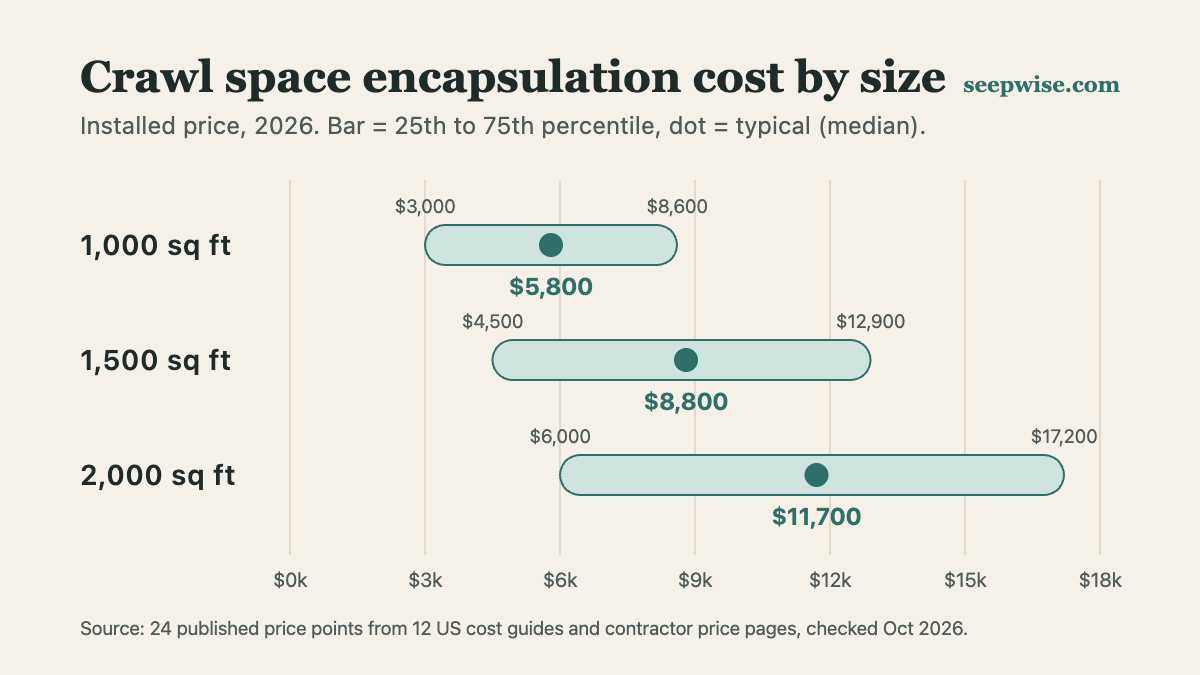
Crawl space encapsulation cost runs $3 to $8.60 per square foot installed. That is about $3,000–$8,600 for a 1,000 sq ft space, and a typical job is near $5,800. The price depends on floor area, wall height and liner thickness. It rises if you need drainage or mold treatment first.
Based on 24 published price points from 12 US cost guides and contractor price pages (2025–2026): $3.00 / $5.84 / $8.60 per sq ft of floor. Low = 25th percentile, typical = median, high = 75th. Method
In this guide
Estimate your crawl space encapsulation cost
Enter your crawl space size and what you need to estimate the cost to encapsulate a crawl space like yours. The estimate updates as you type. For other jobs, see all Seepwise calculators.
Based on 24 published price points from 12 US sources, checked October 2026. The headline range is the average price across published quotes. The calculator prices your specific size and scope, so the two can differ. Your quote will vary.
Assumptions behind this estimate
| Perimeter | — | Square footprint: 4 × √area |
| Wall area covered | — | Perimeter × wall height (not for floor-only) |
| Liner | — | Relative to 12 mil |
| Water or mold | — | Typical drainage add-on before sealing |
| Rates | 24 pts | 12 cost guides and contractor price pages, Oct 2026 |
Have a question about your crawl space?
Send us your question. Reader questions decide what we research and write next.
We can’t advise on your specific home. For anything structural, call a licensed pro.
What’s included in the price
A quote usually bundles several jobs. Each one adds to your crawl space encapsulation cost. Ask for each line separately so you can compare.
| Item | What it is | Typical cost |
|---|---|---|
| Vapor barrier | A plastic liner over the dirt floor that blocks ground moisture. | $2–$4 per sq ft |
| Wall liner | The same liner run up the foundation walls and fastened. | Included in full-system price |
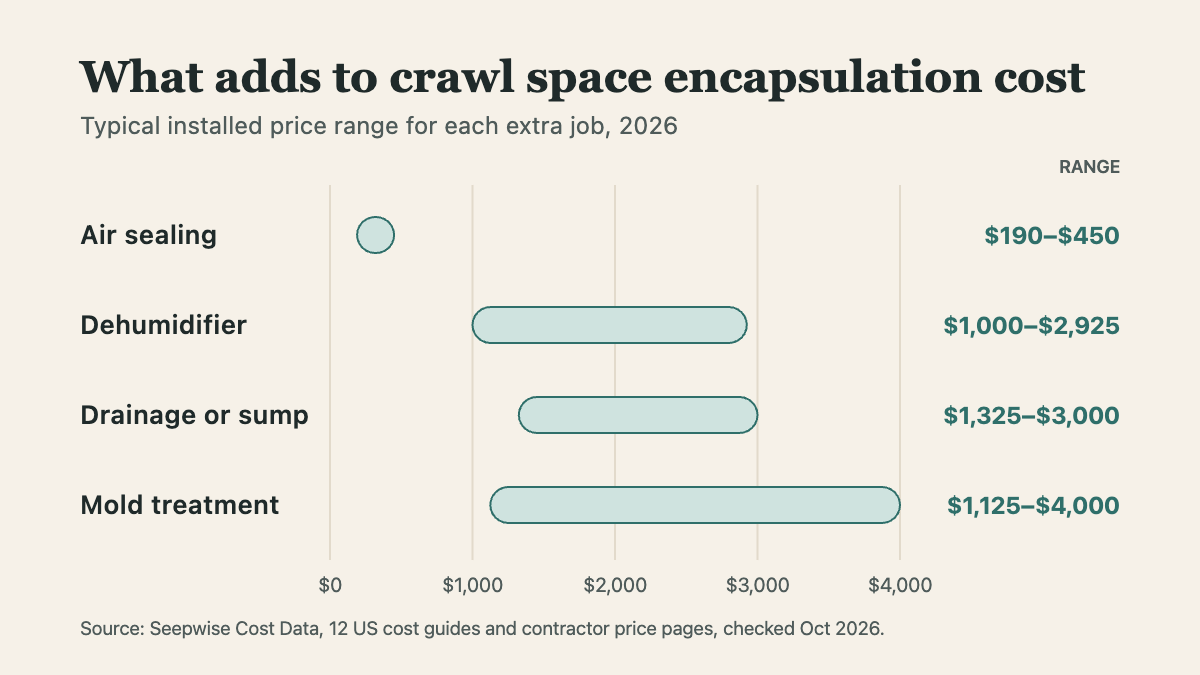
| Air sealing | Closing vents and gaps at the rim joist so humid air stays out. | $190–$450 |
| Drainage or sump | Only if water collects. Moves it out before the liner goes in. | $1,325–$3,000 |
| Dehumidifier | Keeps the sealed space dry year round. | $1,000–$2,925 |
| Mold treatment | Cleaning joists and subfloor before sealing. | $1,125–$4,000 |
Encapsulation vs. a vapor barrier only
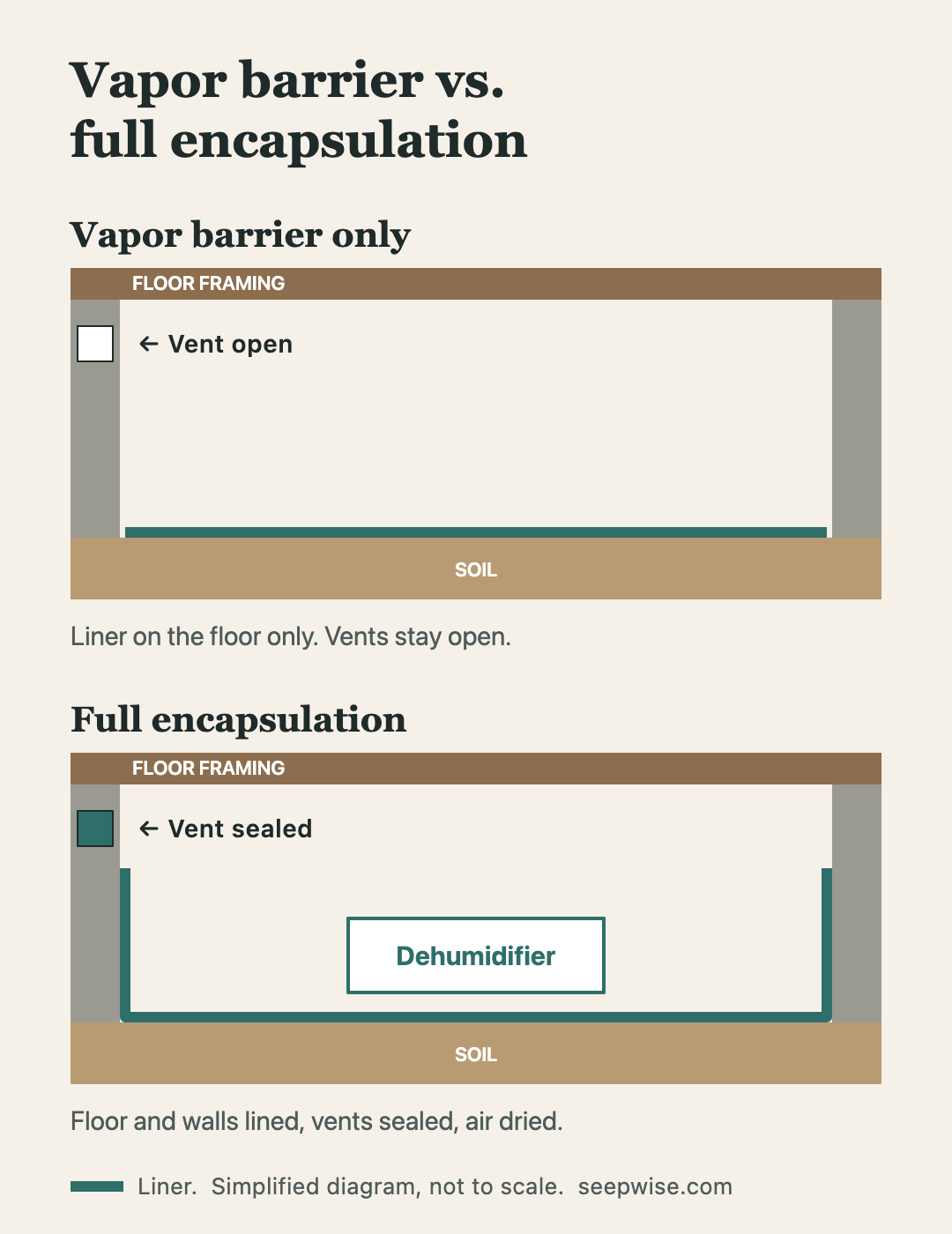
A vapor barrier covers only the dirt floor. Full encapsulation also lines the walls, seals vents and rim joists, and adds a way to dry the air. Here is how the options compare for a 1,000 sq ft crawl space.
| Option | What it covers | Typical price (1,000 sq ft) | Good fit when |
|---|---|---|---|
| Vapor barrier only | Floor liner | $2,000–$4,000 | Dry space, mild climate, no musty smell |
| Full encapsulation | Floor, walls, vents and rim joists | $3,000–$8,600 | Musty smell, high humidity, damp insulation |
| Encapsulation + dehumidifier | All of the above, plus a dehumidifier | $3,450–$9,900 (calculator estimate) | Humid climate or a history of condensation |
If water collects on the floor, neither option is enough on its own. Fix the drainage first.
What affects crawl space encapsulation cost?
Five things move the price most. Check each one when you read a quote.
- Floor area. The biggest driver. A typical 2,000 sq ft job runs about $11,700, roughly double the $5,800 for 1,000 sq ft.
- Wall height. Full encapsulation lines the walls too. A 1,000 sq ft space with 3 ft walls adds about 380 sq ft of liner.
- Liner thickness. In our data, 20 mil liner runs about 3% more than 12 mil, and 6 mil about 7% less.
- Dehumidifier. Adds $1,000 to $2,925 when the installer includes one.
- Water or mold. Drainage adds $1,325 to $3,000 and mold treatment $1,125 to $4,000, and both come before the liner.
How to compare crawl space encapsulation quotes
Ask every contractor for an itemized quote, then check these points line by line.
- Liner thickness and brand. The quote should name the mil rating, such as 12 mil or 20 mil, and the product.
- Wall coverage. The DOE Building America guide runs the liner to within 4 inches of the top of the foundation wall.
- Seams. The building code requires 6-inch overlaps that are sealed or taped. The DOE guide recommends 12 inches.
- Drying method. A dehumidifier (with model and capacity), an exhaust fan or conditioned air. The code requires one of them.
- Water and mold work. Priced as separate lines and done before the liner goes in.
- Warranty. What it covers (liner, labor, dehumidifier) and for how long, in writing.
- Permits and photos. Ask whether your town requires a permit, and ask for before-and-after photos.
Do you need it now?
Monitor
Dry dirt floor, no smell, humidity in the house below 60% most of the year.
Fix soon
Musty smell upstairs, damp or sagging insulation, sweating ducts. Plan it before the wet season.
Call a pro now
Standing water, soft or bouncing floors, or mold across a large area. Fix the water and structure first.
Before you crawl in
Wear a respirator rated N95 or better if you see mold, and stay out if there is standing water near wiring. Turn off power to the area first.
Can I do this myself?
DIY can work if
The space is dry, at least 2 feet high, and you only need a floor liner. Materials for a 1,000 sq ft floor run roughly $325–$650 depending on liner thickness.
Hire a pro if
There is water, mold or low clearance. Or you need drainage, a wall liner and a correctly sized dehumidifier.
A floor-only vapor barrier is a realistic weekend project for a careful DIYer. Full encapsulation is harder. The walls, seams, vents and drying system all have to work together. A basic DIY order looks like this:
- Fix any water problem and let the space dry out.
- Clear debris and sharp objects from the floor.
- Lay the liner with overlapped seams, sealed with tape.
- Run the liner up the walls and fasten it (full encapsulation only).
- Seal the vents and the gaps at the rim joist.
- Add a drying method, such as a dehumidifier, that meets your local code.
When to call a pro
Stop and call a licensed contractor if you see any of these:
- Standing water, active leaks, or water near wiring.
- Mold covering more than about 10 square feet. The EPA says larger areas call for professional guidance.
- Sagging, soft or cracked joists, or cracks in the foundation walls.
- Clearance too low to work safely, or signs of pests.
- Any electrical work for a dehumidifier or sump pump.
How we priced this
In October 2026 we collected 24 published price points. They came from 12 US cost guides and contractor price pages. Each source added its low and high figure. Low is the 25th percentile, typical is the median and high is the 75th, so one unusual quote cannot skew the range. Full details are on our methodology page.
Bottom line
Expect a typical crawl space encapsulation cost of about $5,800 for 1,000 sq ft and $8,800 for 1,500 sq ft. Fix any water problem first. Then get three itemized quotes and compare them line by line against the table above. More help in our crawl space guides.
Crawl space encapsulation: common questions
Is crawl space encapsulation worth it?
Usually, yes, if your crawl space is damp or musty or your climate is humid. Advanced Energy tested 12 homes in the Southeast. The closed crawl spaces rose above 70% humidity only 5% of the time, versus 98% for vented ones. They also used 15–16% less energy for heating and cooling. In a dry climate, the payoff is smaller.
Does crawl space encapsulation add value to a home?
It can, but there is no reliable dollar figure. We found no independent appraisal study that measures it. The benefit is clearer when you sell. A dry, sealed crawl space avoids the moisture, wood rot and mold findings that a home inspection can flag. Keep the contractor’s warranty and invoice to show buyers.
Does an encapsulated crawl space need a dehumidifier?
Not always, but it needs some way to dry the air. The International Residential Code (Section R408.3) gives three options. You can run an exhaust fan nonstop, supply conditioned air at 1 cfm per 50 sq ft, or use a dehumidifier. Local codes can differ. Most installers in humid regions choose a dehumidifier, which typically costs $1,000–$2,925.
Does an encapsulated crawl space need insulation?
Usually, yes, but it can go on the walls instead of under the floor. Building codes let you insulate the perimeter walls of an unvented crawl space in place of the floor. The U.S. Department of Energy’s Building America guide puts rigid foam board on the inside of the walls. That approach needs no insulation in the crawl space ceiling.
Is crawl space encapsulation tax deductible or eligible for a tax credit?
Not federally for work done in 2026. The Energy Efficient Home Improvement Credit (Section 25C) covered 30% of qualifying insulation costs. It does not apply to anything placed in service after December 31, 2025. Work on your own home is generally not deductible. Check state and utility rebate programs, and ask a tax professional.